
Prayer
The children are still in the forest.

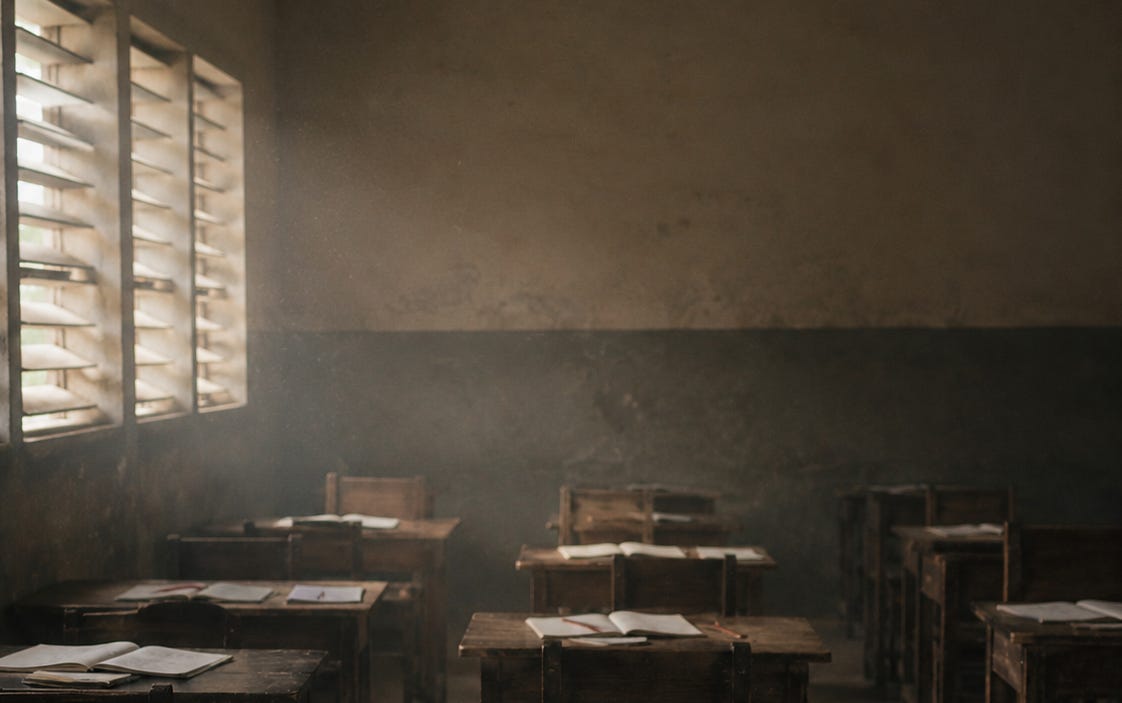
His Children are still writing their exams.
This is the detail that will not leave me. Michael Oyedokun was a mathematics teacher at Community High School, Ahoro-Esiele, in the Ori Ire Local Government Area of Oyo State. He was abducted on the morning of Friday, May 15, 2026, along with his colleagues and their students, by heavily armed bandits who arrived on dozens of motorcycles and moved with the precision of people who had done this before, or had been told, in sufficient detail, how. Two days later, on a Sunday, a video appeared online. His family has since asked Nigerians to stop sharing it. His children, they said, are currently sitting their exams.
I would like you to hold that sentence for a moment. Not the video, not the act itself, which is beyond language and should be, but the sentence about the exams. The ordinary life that was still being lived by people who loved him, continuing in the way ordinary life insists on continuing, even when someone at the centre of it has been taken into a forest in the Old Oyo National Park and has not, nay will not, come back. His children woke up that Monday and went somewhere to write an exam. Mathematics, probably. Or something else. It does not matter what the subject was. The point is that they went to write an exam.
The point is that Nigeria kept going too.
On the morning of May 15, bandits stormed three schools along the Ahoro-Esinle and Yawota axis near Ogbomoso. The schools were Baptist Nursery and Primary School, Community Grammar School, and L.A. Primary School. The bandits took over forty people: teachers, a principal, and children. The youngest were two years old. Before leaving, they set a stolen car alight at the forest line, a gesture that feels almost theatrical in its contempt, as if they wanted to mark the boundary between the Nigeria that still pretends to function and the territory where they have made other arrangements.
An assistant headmaster named Joel Adesiyan was killed during the raid. An okada rider who resisted when they tried to take his motorcycle was shot. The attackers spoke Yoruba, Hausa, and Pidgin. They were not from somewhere else. They were from here, or they had learned to be.
This is what has broken something in the public conversation about insecurity in Nigeria. For years, we organized our anxiety geographically. The violence was northern. It happened in Plateau, in Benue, in Zamfara, in Borno, places that the average Lagos or Ibadan resident had learned to process as a kind of permanent emergency happening at a safe narrative distance. We said "the North" the way people say "the weather", acknowledging it, resigned to it, fundamentally convinced it was not coming here.
Ogbomoso is in Oyo State. It is in the South-West. It is, in the cognitive map of middle-class Nigeria. And so when the bandits arrived at Baptist Nursery and Primary School and rounded up eighteen children, some of them two years old, something shifted, not because the lives lost in Plateau were worth less, but because the geography of denial had finally been breached, and there is no longer a safe distance for anyone to retreat to.
Online, the narrative was simple. “This could be anyone” was the rallying cry. And this is right. That is precisely what has changed. Not the violence, because the violence has been here for twenty years. What has changed is “the anyone”.
Nigeria, I want to speak to you now, directly, because I have found that speaking about you in the analytic third person, with the careful hedging of someone who wants to appear measured, now feels too dishonest in a way I can no longer afford.
You are a country where the Defence Headquarters has attributed the Ogbomoso attack to dislodged Boko Haram terrorists moving through border corridors, and in the same statement called it “an isolated criminal incident.” I need you to sit with that. The same institution that identified the attackers as Boko Haram affiliates, who have spent seventeen years demonstrating that no incident they are involved in is isolated, used the word isolated. This is not a failure of language, unfortunately. This is the specific verbal technology by which the Nigerian state uses in converting catastrophe into something it does not have to respond to at scale.
Meanwhile, in Zamfara State, 725 villages are currently under the control of armed bandits. There is a meaningful portion of Nigerian territory that the Nigerian government does not govern. This is the administrative reality of a country that is, at this moment, preparing for a general election in 2027 and has not yet adequately asked itself whether the communities being buried will even be around to vote.
Governor Makinde said there may not be quick fixes, but that the government would "push to the limit." The limit, so far, is a press conference. The limit is six arrests. The limit is a police AIG relocating his operational base to Ogbomoso. The children are still in the forest.
The children are still in the forest.
I have, since the unfortunate incident, been thinking about what it means to teach mathematics in Nigeria.
To teach mathematics in a public school in rural Oyo State is to participate in a form of faith so stubborn it borders on the irrational. The faith that abstraction matters. That a child who learns to solve for x will be better equipped for a world that is, in visible and daily ways, unsolvable. That the future is worth preparing for. That there will be a future worth the preparation.
Michael Oyedokun was a mathematics teacher. He went to school on a Friday morning in a country where this has always required a specific kind of courage, the quiet, renewable courage of people who show up anyway, who hold the chalk and face the class and proceed to do whatever it is they do, on the assumption that what they are doing is worth something, that someone will live to use it. He went to school on a Friday morning with this belief in mind and did not come back.
His family asked Nigerians to stop circulating the video of his killing. They said it was traumatising his children, who are sitting their exams. They asked that only official family photographs be used. They were asking, in the middle of an unspeakable week, for their father to be allowed to remain a person. Not a symbol, not a hashtag, not forty-eight hours of national outrage followed by the next news cycle. They were asking that he be allowed to exist as just a man, in a photograph, who taught mathematics and is now gone.
I think that is the most Nigerian sentence I have ever heard. The grief policing its own grief. The family managing the country’s response to their own loss. The dead man’s dignity being protected somehow by the people who are burying him, because no one else can be trusted with it.
We are a country that has converted suffering into resilience so many times that we have begun to mistake the conversion for progress. We say "Nigerians are strong" the way a doctor says "he's a fighter," meaning: the system has failed this person, and now we are depending on his personal fortitude to cover the gap. The fortitude is real. Mr Michael Oyedokun’s family’s fortitude is real. Their strength is real.
The gap is also real. And the gap is widening.
The Oyo State Government shut down schools in four local government areas following the Ogbomoso attacks. This is what protection looks like when the state cannot actually protect: the removal of the thing being targeted. Close the schools. Keep the children home. Teach them, implicitly, that the forest is more powerful than the classroom, that the men on motorcycles have already won the argument about whether education is safe.
The OPC, regional hunters, and local vigilantes have been demanding to be armed and authorised to enter the Old Oyo National Park and flush out the bandits. The federal government has not responded. The South-West governors have not responded. The forest remains. The children remain inside it.
Mrs Alamu Folawe, the principal of Community High School, is still in captivity as of this writing. Seven teachers. Thirty-nine students. Some of them two years old, which means they were born in 2024, which means the country they were born into and the country they are currently being held hostage in are the same, and it has not materially improved in the time it took them to learn to walk.
Nigeria, I am trying to pray for you. I have been trying since the 15th of May. The prayer keeps changing shape. Sometimes it starts as anger and becomes grief and then becomes something quieter and more embarrassing, something that feels, if I am honest, like love. The specific, painful love of someone who was born here and has thought about leaving and has not left and does not know, fully, whether that says something admirable about them or something foolish.
I cannot offer you a resolution. I cannot give you the framework or the policy prescription or the cautious note of hope that this kind of essay is supposed to end with. I am aware of what the ending is supposed to look like. I have read enough Nigerian political writing to know the shape of the pivot, the turn toward the future tense, the gesture at dawn, the reminder that we have been here before and survived. We have been here before. We always survive. And then we come back here.
What I can tell you is this: Michael Oyedokun’s children are sitting their exams. Somewhere in Oyo State, right now, in a hall that smells like chalk and bodies and the particular anxiety of young people who know their future depends on what they write in the next three hours, his children are sitting. They are answering questions. They are trying. They are doing the thing their father spent his life teaching them to do, proceeding, despite everything, on the assumption that the answer exists and can be found.
I do not know if that is hope or just inertia. I do not know if Nigeria can tell the difference anymore. I am not sure I can either.
What I know is that I am sending this prayer into the silence, the way you send a message to someone you know is dead and will not be responding, in your moment of grief. And you send it not necessarily because you expect an answer, but because the alternative is not sending it. The alternative is accepting a finality you know deep down you are weeks, months, and even years away from accepting.
And that is a different kind of death that I am not ready for, yet.
The children are still in the forest.
Lanre,
For the Square.